
Owen Pengelly says civil service leaders need to distinguish between productivity and financial efficiency
How should policymakers view the opportunities and challenges of introducing AI more deeply into the UK Civil Service?
As AI transforms the global economy, the Government has clearly signalled its intention to ensure that the UK unlocks the full potential of this transformative technology. The State of Digital Government Review, for example, identified potential savings and productivity benefits of £45–87b per year (4–7% of total public sector spend), while Re:State’s ‘AI and the productivity revolution’ cites one estimate of £200b in productivity benefits to 2030.
But alongside high expectations in Westminster and Whitehall sits much uncertainty about the speed, nature and impact of the change.
In departments and agencies now deploying generative AI chatbots like Microsoft Copilot and Google Gemini, there is a particular emphasis on AI’s anticipated ability to automate administrative or routine tasks, freeing up public servants, especially at lower grades, for ‘higher-value’ work. The good news is that those at the sharp end consistently report increased job satisfaction and perceived enhanced productivity in evaluations of GenAI deployments. However, eye-catching calculations of the potential to reduce and reallocate the budgets and headcount needed to deliver public services in future years could prove optimistic in the short term.
In this article I will explain why, as well as demonstrating that the best way to harvest significant value for our public sector and meet current ambitions is to extend AI’s reach into the processes and systems on which government runs, and to upend settled departmental structures, norms and programmes as part of a more radical organisational upheaval.
The ‘Productivity Leak’ – time saved does not equal money saved
Even as AI becomes an accepted tool in policymaking and the administrative process, translating the benefit of productivity improvements into organisational value that can enhance outcomes, or bear down on budgets, is proving difficult. Productivity gains at the individual level tend to ‘leak’ away – up to 69% of time saved isn’t reapplied to work tasks – in the face of the reality of the modern workplace. That’s not to say there is no benefit here – private sector organisations consistently see a rise in employee loyalty, satisfaction and engagement after the deployment of AI tools, and the same effect is visible in emerging pilot evaluations and people surveys in the Civil Service.1 But happier, marginally more task-productive people don’t free up significant new resources, especially in the comparatively rigid structures of government departments, faced by continually rising demand for more and better services.
The ‘J-Curve’ work on the impact of general purpose technologies by Eric Brynjolffson and others provides a wider perspective on the AI challenge.2 Brynjolffson holds that ultimately transformative new technologies initially depress productivity due to a combination of critical investment in new infrastructure, the need to redesign the way work gets done, the cost of re-skilling the workforce and the drag of legacy processes and technologies underpinning existing services. Once this technology and skills base is mature, productivity tends to soar. In the Sixth Edition of Heywood Quarterly (Winter 2025–26) Professor Anthony Finkelstein eloquently described how the Government will have to surmount what he called the “technology debt” across HMG before it will realise the benefits of AI. Repaying technology debt is insufficient without a broader reconsideration of the operating models of the departments and organisations seeking to realise benefit from AI; the longer this takes, the bigger the risk that AI’s productivity gains will fail to break out of the decades-long trend of productivity growth, let alone drive the sharp upward shift set out in the benign ‘Singularity’ scenario in Figure 1.
Figure 1: AI and GDP per capita – which path?
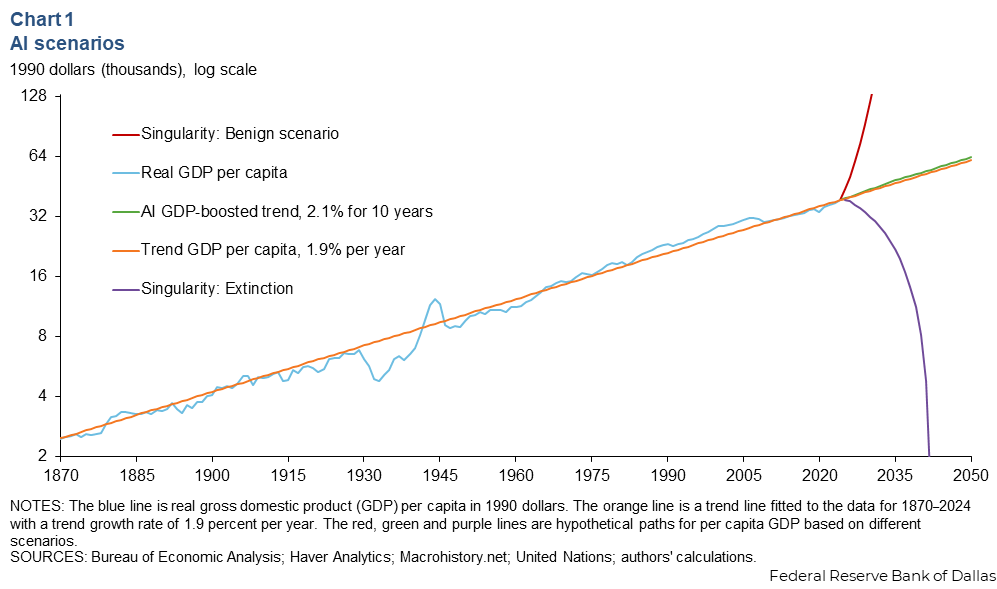
The principal message is that policymakers and operational leaders, as they develop their narrative about the impact of AI on government services, have to distinguish better between productivity (doing more work) and financial efficiency (spending less money).
Defend, extend, upend
A useful way to think about the kind of value AI can bring to any organisation is to segment AI deployments by type of benefit. “All models are wrong, but some are useful”, as the 20th century British statistician George Box once said, so the ‘Defend, Extend, Upend’ framework developed by Gartner is offered here as one pragmatic way of thinking about those different kinds of AI value. In the next sections I will run through these three broad categories of benefit.
Figure 2 – Defend, Extend, Upend
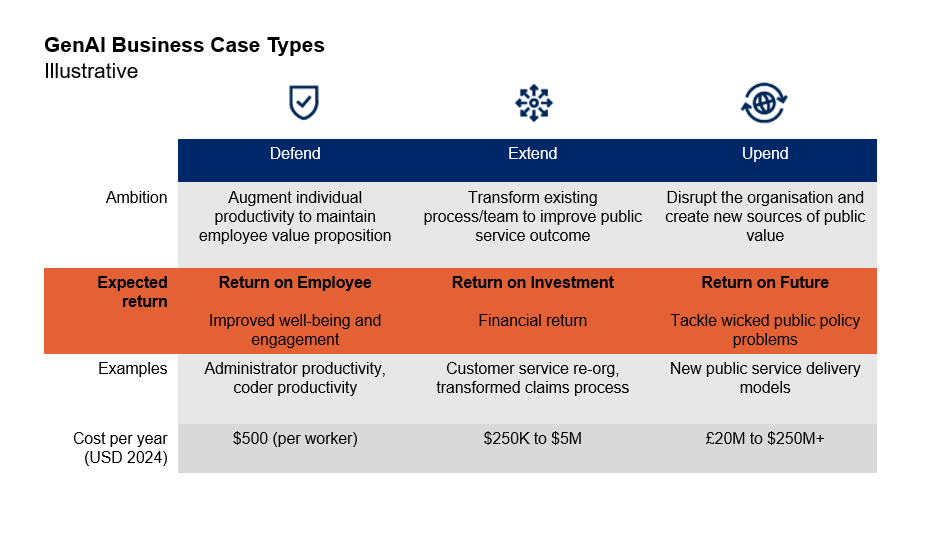
Source: Gartner
Defend – Return on employee
The Defend part of the Framework essentially describes the opportunities most government departments and organisations are now exploring, and the ways they are trying to help individuals get their jobs done more efficiently. AI tools range from general-purpose generative AI chatbots through more specialist tools like those transforming the practice of software engineering, to very early stage experimentation with ‘AI Agents’ capable of taking action autonomously to achieve specified outcomes. By pursuing this innovation, the Government is seeking to make good on the promise of 2025’s AI Opportunities Action Plan, to ‘mainline’ AI into the veins of the nation.
Evaluations of these tools consistently show that they do save time and result in higher quality work, though there are often interesting discrepancies between observed and perceived time savings. A Gartner study found an average time saving of just under 5–5.4 hours per week across all industries in the private sector. In the public sector a recent evaluation of a Copilot trial within the Department for Work and Pensions (DWP) found an average time saving of nineteen minutes per day across eight routine tasks. These marginal gains are also typically accompanied by a greater sense of employee wellbeing and a reported, if not always measured, sense of increased personal productivity.
However, despite the innate attractiveness of multiplying individual minutes gained by large numbers of civil servants, turning time savings into a harvestable return on investment in AI tools – re-purposable headcount or shrinkable budgets – is very hard. Minutes gained per chatbot user quickly ‘leak’ away into activities ranging from learning about how to use the AI tool, having an extra cup of coffee or a watercooler chat to focusing on a new task. So rather than Return on Investment (RoI) departments should think about deploying AI tools in this way as RoE – Return on Employee.
Why do we characterise these moves as ‘defensive’? The reality of today’s workplace is that access to AI tools has become a pre-requisite for any modern organisation wishing to attract, and above all retain, scarce talent in an increasingly competitive marketplace for skills. And the Civil Service – unable to compete with the private sector on salary alone – has a particularly acute need to be able to bolster its employee value proposition.
Extend – Return on Investment
To find harvestable – repurposable, if not always narrowly cashable – value in the form of genuine RoI from investment in AI tools, civil service leaders need to extend AI’s reach into the processes and systems on which departments run, and which support interactions between service users and the state. Gartner research shows that Generative AI can improve the productivity of customer service by between 14%–34%. This is wholly different sort of work from the ‘defend’ benefits of AI productivity tools like Copilot and Gemini, and is well-suited to the programmatic rigour and investment appraisal processes of central governments.
Examples include Singapore’s ‘Sense’ capability, which uses AI to optimise the policymaking process, enabling natural language querying of multiple agency data sources using large language models fine-tuned on policy definitions. This has unlocked annual savings of $800,000 in participating agencies. The Government of Spain, meanwhile, has implemented AI document summarisation and anonymisation of complex legal documentation, thereby allowing the redeployment into higher-value work of staff formerly engaged in manual processing of unstructured information.
Other potential areas where costs can be cut include the use of AI to correct information asymmetries between a department and its key suppliers, especially in the digital domain, to support a commercial re-contracting strategy. AI-catalysed knowledge acquisition lowers the barriers to entry for potential new suppliers as well as equipping senior civil servants with improved levers for negotiation. Al can also improve planning in an organisation’s internal financial processes, bearing down on the need to hold working capital and resulting in better forecasting. This has the potential to be transformative for government entities of all sizes.
Upend – Return on the Future
This third category of AI investment will require a more profound organisational impact than the previous two. To ‘upend’ a business model in the private sector is to fundamentally change the way an organisation operates and thinks: entering new markets, for example, or finding entirely new ways to do business and provide services using insight or other capabilities flowing from investment in AI.
In the UK public sector there are already globally significant organisations pursuing game-changing advanced AI capabilities, like the UK’s Advanced Research and Invention Agency (ARIA) and the Alan Turing Institute, the UK’s national institute for data science and artificial intelligence. These organisations operate at the cutting edge of research and there is an appreciable gap between their insights and what’s needed to develop a practical mechanism for more humdrum government entities to deploy significant ‘big bet’ resources in pursuit of new benefits. No senior official welcomes the prospect of an appearance before the Public Accounts Committee to discuss the writing-off of an investment that tried – and failed – to ‘upend’ delivery of a vital public service. ‘Upend’ initiatives still need to operate within the limits of existing business processes and investment conventions – like the workaday but profound example of a chemicals and materials science company that built a bespoke GenAI capability able to uncover compounds with an aggregate value of triple the more than $90m investment in the AI and pull-through R&D. There are emerging examples of where AI-infused initiatives have tackled public service delivery challenges previously thought intractable. A 2025 World Bank study found that six weeks of teacher-directed AI tutoring for a cohort of secondary school students in Nigeria produced learning gains equivalent to up to two years of ‘business as usual’ schooling.
The UK Government’s AI targets – embodied in the £45–£87b of annual efficiency savings and productivity benefits identified by the State of Digital Government Review – are commendably ambitious. But they are also sufficiently demanding that to have a chance of meeting them the Civil Service will need to think in terms of such upending of settled structures, norms and programmes.
The workforce transformation
Being hard-headed is just a first step in the fundamental transformation required to seize the benefits and manage the risks of AI in the UK. Technology investment of any kind is nothing without an equal focus on attracting, retaining, training, and where necessary redeploying, the right workforce skills. In the Civil Service this issue is particularly acute, given the longstanding challenge of retaining skills and constraints on hiring scarce specialist AI capabilities. The need for a people-centred approach to AI productivity is all the more urgent given long-running trends like stagnating population growth and increasing competition for skills.
Deep productivity
As AI tools become more common in the workplace, the personal productivity benefits identified in the ‘Defend’ domain accrue differently depending on the experience of the worker using the tool, and the complexity of their functional area. This raises questions for senior civil service leaders about not just to whom they deploy AI tools, but more importantly, how to manage the consequences for staff engagement and advancement in a rapidly changing workplace.
Figure 3 – Zone of Deep Productivity
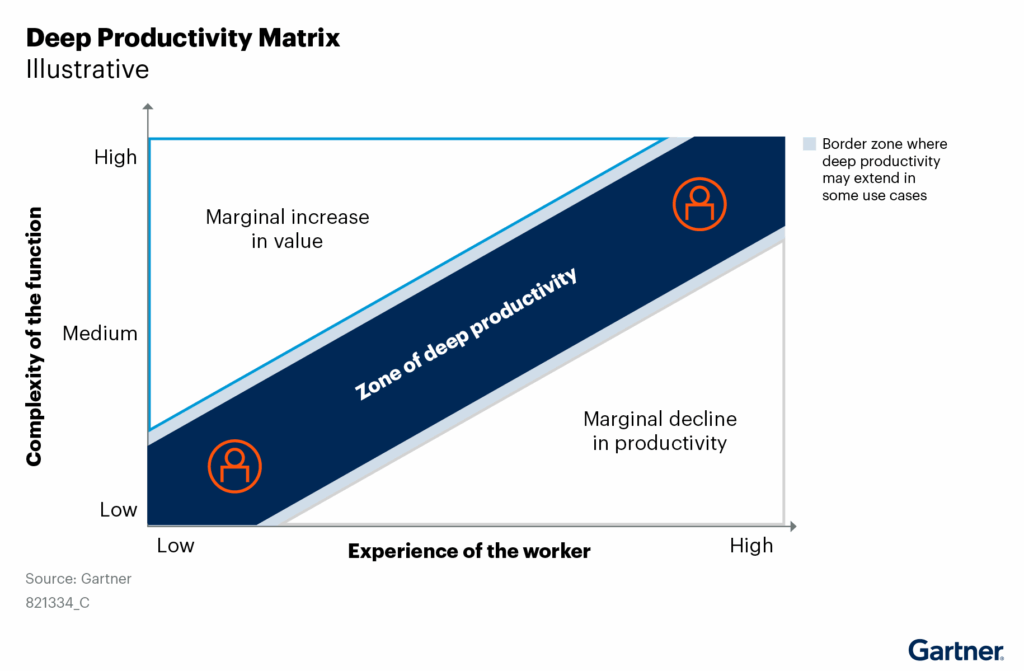
Workers within the zone of deep productivity (Figure 3) will likely become significantly more productive when enabled with Generative AI tools. Those outside the zone will not, and may even experience a decline in productivity at the margin like the ‘productivity leak’ cited previously. There are two explanations for this phenomenon: Experience Compression, and Skill Magnification.
In Experience Compression workers with relatively limited experience, performing relatively low-complexity tasks, will learn more quickly.3 One US government study (albeit of a commercial enterprise) found call centre workers were as productive after two months with AI tools as their predecessors had been after six, and after six months in the role were performing at a level approximately 50% higher. There are obvious parallels to customer-facing and information-processing civil service roles here – supported by many of the early evaluations of the internally developed AI Exemplars.
The counterintuitive phenomenon of Skill Magnification is especially interesting for the senior Civil Service. In this case, at the top right of the ‘zone of deep productivity’, experienced workers in complex roles typically become more creative when given access to generative AI tools. Leaders learn to use AI to challenge or simply fine-tune their thinking, considering options from different perspectives. CFOs in particular benefit from AI tool-assisted investment appraisal; securely-implemented AI tools can confer similar benefits on a range of analogous C-level analytical tasks. For civil service leaders, the productivity value of Generative AI lies not in time savings but in better strategic decisions.
Structural implications
The biggest impact of this differential ‘AI effect’ on skills acquisition and capability enhancement across the workforce could be a significant re-think of civil service career and organisational structures. If entry-level hires accumulate experience more rapidly, and leaders become more creatively empowered and effective, what will the future hold for the traditional core of SEO to Grade 7 policy and delivery roles, and how will expectations be managed around the pace at which civil servants develop towards and through them? Interestingly, the relatively structured nature of many civil service career journeys – development programmes like the Fast Stream, an enduring culture of expected ‘tour lengths’ in some departments – could provide an insulating factor against the ‘jobs chaos’ becoming apparent in the relatively more dynamic employment market outside government.
Though probably too soon to discern workforce effects, in the near future these workforce-structural effects of AI-driven productivity changes might begin to show in the overall distribution of grades within departments. One hypothesis applying to organisations generally is that traditional ‘pyramid’ grade structures will become more column- or even inverted pyramid-like, as phenomena like experience compression and skills magnification are felt. Civil service organisations subject to these changes would most likely be large operational delivery-focused departments like the Department of Work and Pensions and the Ministry of Justice. The structural effects on more ‘diamond-shaped’ policy departments will likely be more subtle – but in each case, departments will need to confront a tightening race for AI-literate talent at the top and a need to catalyse the AI-learning of less-experienced staff.
Conclusion – what would Jeremy think?
I had the privilege of serving as Private Secretary to Jeremy Heywood, for whom the Quarterly is named, during his time in government. The present generation of AI tools provided to civil servants, both those responsible for policy and those for delivery, evoke something of the former Cabinet Secretary’s formidable analytical and summarisation skills.
No doubt Jeremy would have recognised the human motivation to turn some of the minutes gained per day into an espresso or two. But he would surely also have understood that the true, profound value of AI for improving the Civil Service and wider public service delivery lies in applying its formidable capabilities to reimagining the systems and processes that underpin it all. And in doing so, he would surely have wanted to pursue equally profound, perhaps uncomfortable, changes to the Civil Service workforce, so as to develop more mission-oriented and more satisfying roles for those at the heart of public service.
Owen Pengelly is a Vice President, Executive Partner with Gartner. He served in the Cabinet Office, Treasury and Department for International Trade from 2004–2019.
Footnotes
- Government Digital Service, ‘365 Copilot Experiment: Cross-Government Findings Report’, 2 June 2025.
↩ - E Brynjolfsson, D Rock, and C Syverson, ‘The Productivity J-Curve: How Intangibles Complement General Purpose Technologies’, National Bureau of Economic Research, Working Paper 25148, January 2020.
↩ - Department for Science, Innovation and Technology,
‘AI Exemplars Programme‘.
↩