


Justine Greening recalls a checklist she once wrote for Sir Jeremy Heywood
Editor’s introduction:
HM Treasury is arguably the UK’s most high-profile and most important government department. Its culture, its processes, its range of expertise and its ways of working are therefore all vital for our future prosperity.
The two articles published by the Heywood Quarterly in the Ninth Edition by former Government Minister and social mobility campaigner Justine Greening, and by John Kingman, former Second Permanent Secretary to the Treasury, shine valuable light on these matters and will, we hope, open up a constructive debate about possible future reform.
Justine’s article draws on her time as a Government Minister in three spending departments up to 2018 and specifically on points she made in a memo to the late Cabinet Secretary Jeremy Heywood. John’s article provides a riposte to some of Justine’s arguments, as well as his own critique of what could be improved.
We will welcome other contributions from writers inside and outside the Treasury and have plans soon to publish an article authored by a senior HMT official. We also welcome constructive articles about other parts of government in the spirit of creating a positive debate.
As Secretary of State for Transport, then International Development and finally Education in the years from 2011 to 2018, I used to call HM Treasury (HMT) the UK’s ‘great unreformed government department’.
Just a few months into Andy Burnham’s premiership in the autumn of 2026, it’s encouraging to note that change at the Treasury may finally be afoot. Though the new Prime Minister’s main emphasis so far seems to be on the devolution of expenditure and tax, for me, the reform agenda should be far broader than that.
I say this not only as a former Minister at three very different spending departments, but as a chartered accountant who is also a former Treasury Minister. Prior to Parliament, I had a career in industry, working in huge multinational businesses. Now I am a non-executive director at a publicly owned travel company and campaign for social mobility.
My thinking on reform of the Treasury goes back at least to 2017 when, as Education Secretary in the then Conservative Government, I drafted an iPhone note as an aide-memoire to myself ahead of a meeting with the then Cabinet Secretary Sir Jeremy Heywood. Frustrated by how much easier it was for ministers to make the case for mending potholes than investing in people, I felt it was important not only to set out the problems but, more constructively, to come up with possible solutions.
My hypothesis was that the combination of the Treasury’s business case methodology, its failure to value human capital investment effectively compared to physical and infrastructure-led investment, and the economist-skewed skillset of its officials was driving the UK to over-index investment in physical capital versus investment in people. At a time when talent and creativity were increasingly driving economic growth, it seemed like a strategic imperative to try to alter that balance.
My concern at the time was that we didn’t know the extent of this investment bias and without that information it was far harder to decide the best relative investment mix between competing priorities. The Cabinet needed a clear line of sight so as to be able to make necessary trade-offs and assess the impact on our public finances in the short, medium and longer term.
It’s worth emphasising that I said to Jeremy at the time that HMT would never reform itself; the impetus would need to come from the outside through an external reviewer.
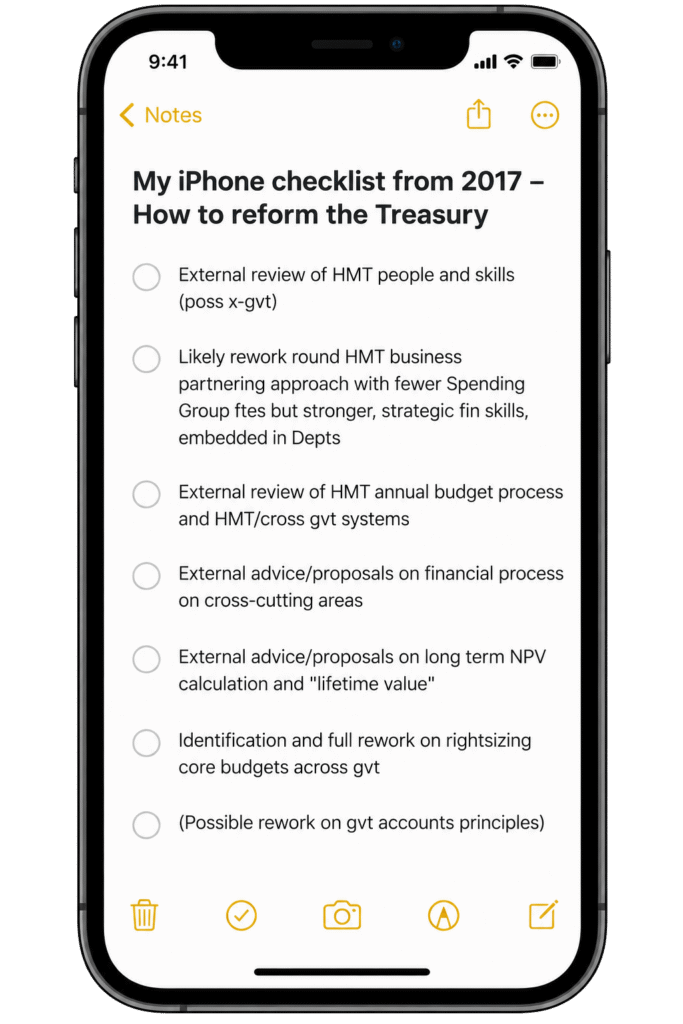
My checklist (dated 9th November 2017) was not comprehensive, but it contained points I’d later make in my final debate in Parliament in June 2019 on ‘Treasury Reform and Social Mobility’. Then I made the case that HMT reform was essential if we were to make any significant progress on social mobility.
Let’s take some of the iPhone points in turn, notably the issues of having the right people, people with relatable experiences (which will create the right culture), the need for better processes and the need for better information to drive human capital investment.
More accountants, please…
I was then of the view (and still am) that there weren’t enough accountants, particularly when it came to the Public Spending team. As I’d point out to them, I’m an educated, intelligent person but I’m not a trained lawyer, so don’t expect me to head to the Old Bailey and prosecute a legal case. The Treasury needs trained accountants because only they have the expertise to manage complex finance and work cross-departmentally on business cases, as well as the judgement to know when financial issues need to be quickly resolved and when they can be managed over a longer timeframe. It’s inconceivable that any major PLC would have a finance team staffed with generalists, however clever they were. Interestingly, the Sainsbury Review in 2013 reached a similar conclusion, that heads of finance needed to be experienced and qualified, though only some of those recommendations were acted upon.
A normal finance team approach in any other organisation (public or private sector) would be a central finance team with departmentally located ‘business partners’ embedded in the teams they support. That concept might send a chill up the spine of permanent secretaries in other departments, but only because of the weak trust between the Treasury and other departments thanks to the former’s modus operandi of playing off departments against one another, Hunger Games-style.
In my experience, the departmental-facing public spending teams in the Treasury were too distant and disconnected from the departments they scrutinised.
One discussion I had as Education Secretary, on schools’ efficiency, illustrates the point. While I had been hoping to get onto the topic of school estates – notably how they could potentially be opened up for greater community use (perhaps generating revenue that could be reinvested) and what alternatives there might be on ed-tech and efficiencies – the lead Treasury official’s perspective on inefficiency was quite different.
“Too many deputy heads” was the issue raised with me. “OK, interesting, we can discuss that – anything else?” I asked. “We want to focus on deputy heads,” came the response. I questioned what the HMT hypothesis on deputy heads was in relation to schools’ efficiency. Clearly, headcount organisation and efficiency might be one element of a broader efficiency strategy but most schools employ a variety of people in a variety of roles. It didn’t make sense to take a narrow focus on a single role instead of looking at headcount across the board.
It turned into an unstrategic, simplistic discussion that left my inner accountant feeling deeply unsatisfied and efficiency opportunities unexplored.
Equally, it was hard for departments to work collaboratively because they never knew who might end up facing a funding shortfall. An approved joint project might see all departments involved funded as requested from HMT, or just some of them. Any department given partial funding was therefore left with a difficult decision – either they had to cover the shortfall from elsewhere in the departmental budget, ask another department to cover the shortfall (which was unlikely) or pull out of the joint project entirely, meaning it might not proceed at all. It was a disincentive to working collaboratively and often it just felt easier and less fiscally risky to work independently with full departmental control.
…With relatable experience to drive the right culture
Then there is the tough question about the degree of HMT’s relatable experience. Does a department with proportionately more officials who have had a privileged start in life than other departments really have sufficient, collective relatable experience to shape policy affecting lives and communities that can be so different in circumstances and upbringing? This is an observation, not a criticism, but nevertheless an important one. No one chooses where they start in life, but if it is a national priority to put in place a comprehensive, multi-departmental ‘pro-social mobility’ investment strategy, we need HMT officials with relatable expertise, understanding the lives that policy is designed to help. Too often during my time in government I felt I discussed issues with people whom I greatly respected, but whom I knew had no easy reference point to the lives I talked about, even the life journey I had had myself. This is about subtly changing HMT’s culture. My firm view is that we’d see more investment in children’s services from a Treasury staffed by more officials with closer experience of the care system, either directly or through their family or their community.
More encouragingly, it’s worth mentioning here that the majority of those being recruited to the Darlington Economic Campus (sometimes referred to as No. 11 North) are new to the Civil Service and have come with experience from other careers. Early entry routes are also more diverse. Let’s hope that experience can be taken back to Whitehall and No. 11 ‘South’.
Unreformed processes
As for process, the Treasury’s operating model remains as it always has: the Budget statement, spending reviews, departmental bids, short spending cycles and a relentless focus on what can (or can’t) be fiscally scored now. In the final stages of a Budget process, as Education Secretary, I was once told that “Treasury want to know what can be done on maths for £40m, the Chancellor wants an announcement.” Welcome news, but it didn’t seem the most strategic way to craft an overall strategy on maths, nor on public finances. Too often I felt we ended up with piecemeal, patchwork ‘announceables’ that risked failing to work as a whole.
Others share the same conclusions I came to in government, most recently the authors of a five-year Nuffield-funded research project driven by the Bennett School of Public Policy at the University of Cambridge. “The research shows,” they wrote, “how the UK has maintained strong aggregate fiscal discipline, but at the cost of an increasingly fragmented, short‑term and incoherent system of public spending – one that struggles to support strategic investment, cross‑government working or sustained improvements in outcomes.”
I still find it odd that the Chancellor, via the Budget statement and spending review processes, effectively delivers the Government’s annual strategy presentation in Parliament rather than the Prime Minister. In the private sector it’s the CEO, not the CFO, who does this.
Just as strange is how HM Treasury and No. 10 have their own separate set of “outcome measures” associated with the Spending Review. No successful organisation sets strategy in two places – potentially in conflict with each other and each with its own set of key performance indicators. The arguments on the Defence Investment Plan between the then Starmer No. 10 operation and HMT highlight the consequences.
Human capital investment
It’s understandable that government borrowing is a key focus for HM Treasury but even that has become self-defeating. The current measure of Resource Departmental Expenditure Limits (RDELs), the budgeting term for multi-year limits set by the Treasury on day-to-day operational public spending, fails to sufficiently differentiate between the ‘human capital’ investment that a 21st century economy needs, whether investment in education, or in upstream prevention of lives going off track, compared with the day-to-day spending on things like welfare, roads maintenance and the justice system. It’s all classified as the same and therefore both sorts of expenditure are seen as costs that HMT wants to minimise.
The arguments around conducting proper business cases for human capital, or social infrastructure investment, have admittedly been well rehearsed elsewhere but they remain unaddressed. The only sustainable strategy for reducing the deficit over the long term is to put more lives back on track. Where is the HMT fiscal and investment strategy, backed with an evidence-based, ‘theory of change’ approach, that would allow us to pivot to this virtuous circle over time? What portfolio of long-term investments would drive reduced welfare, RDEL more generally and increase income tax take – and what would be the payback period? I believe it is now time to split out a third spending control category, Human Capital Departmental Expenditure Limit (HDEL), alongside Capital Departmental Expenditure Limit and RDEL to categorise human capital investment in a transparent way.
Additionally, if HMT was able to develop an understanding of investment in people (and places), not just infrastructure projects, it might have a stronger baseline, ‘counterfactual’ in HMT language, against which to judge HDEL investment and its likely efficacy. We’d have an assessment of the baseline future ‘opportunity cost’ of a child in care, a child growing up in deprivation or with health challenges, those Not in Education, Employment or Training (NEETs) or an ex-offender highly likely to re-enter the justice system. We can look ahead to the ‘lifetime’ fiscal impact of lives off-track. It is the real RDEL/HDEL ‘counterfactual’ we need policy to address, which would naturally provide a fresh approach to look at relative department investment ‘sizing’ and feed into trade-off decisions on preventing long-term hardship vs. current spend alleviating it. The recent “Young People and Work” interim report by Alan Milburn identified that the Department for Work and Pensions spent “around £25 on benefits for every £1 on employment support”. That’s £25 of RDEL for every £1 of HDEL under the categorisation set out above.
If we are heading further down the devolution track, how can HMT help regions strike the right balance between costs, incentives and benefits? Sharing the proceeds of lives on track with devolved authorities, for example the gain-sharing of successfully reduced welfare bills, would align benefits to costs at a more local level. It could be the fiscal approach to drive savings across the board, for example: lower welfare bills, lower justice system bills and lower children’s and adults’ services bills.
Conclusion
So what actually happened at my meeting with Sir Jeremy? Did my HMT Reform iPhone list ever get actioned? When we met, Sir Jeremy was sympathetic and a listening ear. He recognised many of the points I was making but we both knew by then that Brexit would steadily take over the entire bandwidth of government. And so it proved. The issues nevertheless remain, which is why I return to them a decade on in this essay.
It’s easy to feel defensive when being challenged to change and reform. It’s inevitably taken as a criticism. And some of my points are essentially saying the Treasury needs to ‘up its game’. But my urgent call for reform comes from a place of belief in a department which I think is fundamental to getting the country back on track. It’s one in which I was hugely proud to be a Minister. Professionally as an accountant, it’s my ‘home department’ kith and kin. I want it to be the best version of itself because that’s what Britain needs.
HMT reform is an opportunity. It’s not about dismantling the Treasury; it’s about unlocking its undoubted talent as a crucial department, vital for the UK’s prosperity. It needs the right people with the right relatable experiences, the right processes, the right information systems and the right culture.
HMT has always been the first to push other government departments to change. Now it needs to grasp the nettle itself. I hope it has the confidence to do so.