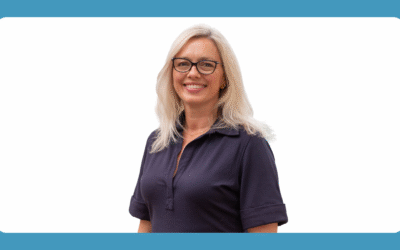

Lucy Heywood describes a day in the life of Victoria Harrison – and her “Ambassadog”, Otto
Victoria Harrison, Britain’s first blind Ambassador, has been in post in Slovenia for just over a year. Her historic appointment in August 2024 was the culmination of a journey that began in the late 1980s when events in Central and Eastern Europe, including the fall of the Berlin Wall, sparked her interest in international affairs. As a teenager, 10 years before the complete loss of her sight, she remembers watching it all on television. Around the same time, she discovered that diplomats do “exciting things” like travel the world and learn languages. From that moment on, her heart was set on a career in the Foreign Office.
Growing up in the London borough of Greenwich, Victoria often saw the town’s sign proclaiming its twinning with Maribor, the second-largest city in Slovenia. Next year marks the 60th anniversary of this enduring international relationship and it is a matter of great personal delight that she will be able to take part in the celebrations.
After graduating from university, Victoria started in the Diplomatic Service Fast Stream, took up her first diplomatic posting in Finland, moved to Sarajevo and then back to London in various roles. Now with the help of her guide dog, Otto – her “soft-power tool”, as she calls him – Victoria leads Britain’s mission in the Slovenian capital Ljubljana.
The journey has not been without its difficulties. At times, Victoria recalls feeling like “an exhibit in a museum” and was sometimes questioned about her ability to do her job. When she first joined the Diplomatic Service, she felt people were unsure about how to react to her disability, and in the early part of her career there was relatively little in the way of accessibility accommodations. There were even questions as to whether she could learn the languages required for her postings – despite already having several languages under her belt.
Being accompanied by Otto raises its own challenges, including access arrangements in airports and the additional costs of vaccinations. Each airline has its own administrative hurdles.
Life at the embassy can vary greatly from day to day, be it travelling around the country or attending a host of events and other commitments. Here is a ‘typical’ day in the life of Victoria and Otto when in Ljubljana.
Victoria’s morning begins in the ambassador’s residence, where her first priority is not emails or policy briefings, but breakfast for a hungry dog. Once Otto is fed and happy, she tunes into Slovene radio and news channels, a key part of her daily routine to help sharpen her language skills. Since many of the people Victoria speaks to on a daily basis tend to speak English, she takes every opportunity to speak and listen in Slovene.
Ljubljana is much smaller than London, so the commute around the Slovene capital is far easier than the one she is familiar with back home. It’s a 15-minute walk from the Residence to the embassy – though slightly longer if she and Otto find themselves waylaid by passersby, who recognise them from television or social media. After his fair share of attention and pictures, Otto gets Victoria to work, right on time. Whilst Ljubljana is pedestrianised, it took the pair a while to become accustomed to a nation of cyclists. However, after a year in the city, it feels like home.
0800. Team meetings in the embassy
Once in her office at the embassy, Victoria’s working day begins with emails, meetings and briefings with her small but dedicated embassy team.
Colleagues have quickly adapted to her needs and ways of working over the past year, and internal meetings generally concern strategy and working out the British approach to issues of the day. Otto, meanwhile, can sometimes be spotted visiting different parts of the office, though he also enjoys the attention he receives from visitors, or just falling asleep until he is needed again.
0900. Meetings outside the embassy
Victoria likes to get out of the embassy as much as possible. She attends plenty of external meetings, with Otto equally enjoying his responsibility of guiding her through the streets of Ljubljana or riding in what he thinks of as his official car, where he loves to nap and recharge.
With the UK and Slovenia both being members of NATO, meetings frequently take Victoria to the Slovenian Foreign Ministry or the Ministry of Defence. There are many mutual defence priorities, for example in Ukraine, a priority for both countries.
Victoria notes that her disability often helps to bring out the inherent humanity of the situation. When coffee is brought, she may need assistance in finding her cup – this moment of lightness between her and her counterpart transcends the formality of titles and the potentially tense dynamic at play. By the end of the meeting, there is a human connection regardless of priorities and any frustration that might have stemmed from issues under negotiation.
1000. Science conference
A key part of life as ambassador is engaging in parts of Slovene life beyond the geopolitical. This morning, Victoria is attending a conference about collaboration and science, which highlights where more connections could be formed between Slovenia and the UK.
Despite being offered a headset with a translated interpretation of the discussions, she opts to listen in Slovene. Though the language used is complicated and highly technical at times, this is another valuable opportunity to continue to improve her language skills.
Although the Foreign Office provides intensive language training prior to postings, this ends once a new role begins. It’s up to Victoria, therefore, to keep up her language learning, something she plans to enhance through monthly language exchanges with her fellow ambassadors in Ljubljana.
Technology has been a huge help for learning Slovene, though without any accessible online Slovene dictionaries she had to resort to ChatGPT as a dictionary and grammar tool equivalent. Whilst technology develops rapidly, assistive technology often lags behind.
1200. Lunch
Lunch is rarely leisurely for a busy ambassador, so it will either be a quick and unglamorous sandwich at her desk, or a work-related event. Today it’s the latter, as Victoria has an event in the local community.
Slovenia, she notes, attaches a high importance to work-life balance, meaning that events are more likely to be held at lunchtime in the middle of the working day rather than cutting into the evening (though in her job, evening commitments are inevitable).
Thankfully, Otto doesn’t mind whether he’s roaming around the garden or being admired at a reception.

Victoria and Otto celebrating King Charles III’s birthday at the Ambassador’s Residence.
1300. Mentoring
On a typical day, Victoria might host a variety of guests for coffee in the residence, from journalists to new ambassadors, where the homely atmosphere encourages relaxed discussion and relationship building.
Today, she is mentoring a blind member of another country’s diplomatic service which has no senior diplomats with visual impairments. Advice and guidance based on Victoria’s own experience can be invaluable to young diplomats with accessibility needs. On International Day of Persons with Disabilities in December 2024, Victoria also invited a visually impaired university student from Slovenia to shadow her and take part in the “Ambassador for a Day” scheme.
Projects like these are a great platform, both for mentees and for raising the profile of those with disabilities in the workplace. Victoria emphasises the importance of ensuring that those with disabilities, whether in education or entering employment, have the confidence to apply for opportunities and advocate for their needs – but she also stresses the need to recognise individual strengths. She hopes that drawing attention to people with disabilities and highlighting their achievements in the workplace will inspire more young people to recognise their capabilities and take the risk of applying for opportunities – even if past experiences have been discouraging.
This is an important aspect of Victoria’s work. With only 27% of people registered blind or partially sighted in work in the UK– far less for those with complete vision loss – Victoria acknowledges that the UK still has some way to go to provide adequate support for those with disabilities in the workplace (including the public sector). But she believes Britain still has a good record relative to many other countries and is proud that it serves as a positive example of the progress that has been made, especially in shifting attitudes.
1400. Speech practice
Many people in high-profile positions struggle with giving speeches, but it’s much more daunting to deliver a speech in a language that you cannot simply read out – and is not your native tongue. Whilst Victoria has given countless talks in the past about her life and work, speeches which deliver key messages on topics such as trade policy and Ukraine can be much more difficult, not least because of their sensitivity and the need to choose words carefully. An additional challenge is the relatively poor quality of synthesised Slovene voices when compared to their English equivalents, given that it is a much smaller language.
Memorising long speeches in Slovene, then, takes time and effort. For today’s session, Victoria has asked a native Slovene speaker to create a recording – especially helpful when she finds herself slipping into Bosnian pronunciation, one of many languages that she has studied throughout her career. Her teacher is helping her practice pronunciation and which words to stress. Repetition is a crucial step; sometimes she starts at the end of the speech and builds backwards until she knows it inside out.
Victoria is happy to give speeches in Slovene, knowing that when she does, the local language will have a greater impact on the audience.

Victoria Harrison speaking at an event.
1600. Commemoration event
With 2025 marking the 80th anniversary of the end of the Second World War, Victoria’s calendar has included many commemorative events this year. Among these was one for The Crow’s Flight, one of the war’s biggest prisoner of war escapes, when Allied POWs fled through Slovenia with the aid of local partisan fighters. Victoria has also made visits to the sites of RAF plane crashes and their memorials throughout Slovenia as part of the anniversaries.
These events are solemn reminders of the costs and sacrifices of war, but they are also deeply significant to the relationship between Slovenia and the UK. Above all, they are commemorations for the many locals who risked their own lives to help the injured and give the dead dignified burials. At these events, Victoria meets and speaks to those who, despite being children at the time, witnessed the tragedies first-hand.
Such anniversaries highlight the importance of shared memories. As Britain’s ambassador to Slovenia, Victoria represents the historical connection between the two nations.
1800. Ministry for Foreign Affairs ambassador conference
Evening events are a necessity in the diplomatic service, and there are often several on the same day.
This evening, Victoria is attending a reception hosted by the Ministry for Foreign Affairs – the Slovene equivalent of the Foreign, Commonwealth and Development Office (FCDO). Such occasions are more than just ceremonial. At this one there might be an opportunity to discuss trade and cultural exchanges with other ambassadors. Whilst the topics are serious, the atmosphere will be more sociable than at more formal meetings, and provides a chance to strengthen relationships with Slovene officials and her opposite numbers from other countries.
Far from being fazed by noise or large numbers of people, Otto sees these gatherings as a welcome opportunity to exercise his celebrity status as “the Ambassadog” and pose for photographs – a trick he has recently learned. This extra attention and being in a different environment makes this one of Otto’s favourite times of day.
2100. Time for a walk in the park
If time permits, there will be a final walk before bed, either in the park or in the garden of the ambassador’s residence. On quieter evenings, Victoria enjoys tandem cycling or a session on her spin bike, though on this occasion there is little space left for ambassadorial downtime.
Another day of meetings, speeches, receptions and all-important admiration for Otto awaits them both.

Closing thoughts
There are two key takeaways from Victoria’s typical day.
Firstly, the importance of advocacy. Victoria was the first blind person to be recruited into the Diplomatic Service, joining in 1997. This was shortly after the passing of the Disability Discrimination Act, and many of Victoria’s experiences have been – unintentionally – trailblazing. While the Civil Service has made significant progress in supporting Victoria and others with disabilities, with peer support playing a vital role in that, challenges remain. With nearly one in seven Foreign Office staff declaring a disability, Victoria believes more can be done to remove the barriers they face. One thing that would help is a better understanding of the potential of disabled colleagues in the workplace, not just the areas where they require support. That said, she adds, those with disabilities should be confident and unapologetic in asking for what they need.
Secondly, in a world of increasingly manufactured reactions and outrage, connecting on a personal level is a necessity. Victoria’s work as an ambassador highlights a truth too often overlooked – that diplomacy is as much about human connections as it is about politics, and that our differences and diversity of experiences should be seen as an advantage and opportunity for development, rather than a barrier.