
Sir Rich Knighton, Chief of the Defence Staff, on the next-generation battlefields
I was given a first-hand insight into some of those changes when I visited Ukraine a few weeks ago.
While I was there, I was taken to the area northwest of Pokrovsk to meet soldiers who had been fighting on the front line. They wanted to show me the juxtaposition of the old Soviet-style Corps headquarters and the most modern and lethal example of what passes for today’s hand-to-hand combat.
In the 9th Corps headquarters there were large maps on the wall with pins stuck in them and string threaded between them, signifying the front line or concentrations of troops. The headquarters was hidden in a nondescript building in the middle of a small town – it was a scene that would have been familiar to those who had fought in that region in the Second World War.
From the Corps HQ I moved to the 425th Assault Regiment headquarters, a bit closer to the front line. There I met young men who had been fighting for Ukraine since the start of the war. Soldiers who had been civilians, painters and decorators and van drivers when Russia invaded. Their commander was a bear of a man, with biceps bigger than my thighs and with scars on his face from the battles he had fought.
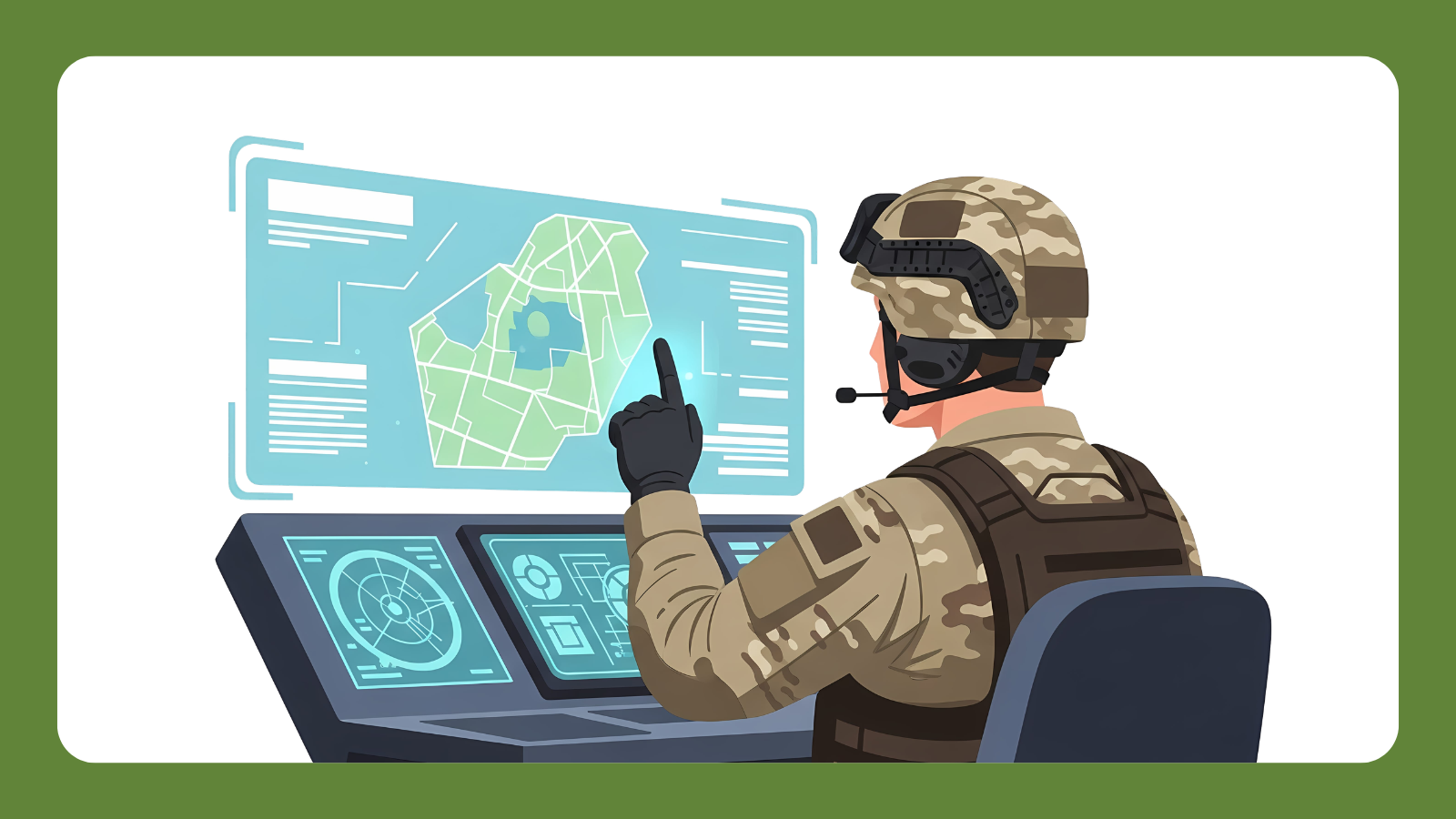
The battle for Pokrovsk was being run from his headquarters. In half a dozen rooms in a civilian building in the countryside, men in uniform sat behind computer screens with digital maps and live feeds from drones flying over the town. These drones were being used to look for the enemy, to attack enemy positions and to destroy other drones. In some cases, the grainy pictures on the screens were in fact the intercepted signals from Russian drones, a real-time window to the battle.
The fighting in and around Pokrovsk was fierce. Fighting at close quarters amongst the rubble was still a fundamental part of the battle, but both sides relied increasingly on relatively cheap mass-produced drones to find and kill their enemy. At night they would move under the cover of a thermal blanket – a sort of invisibility cloak – to avoid being seen by thermal imaging cameras on the drones.
A little further away from the front line, we changed vehicles and were taken in separate unmarked cars by Ukrainians from the Unmanned Systems Force to a secret location. Inside the makeshift headquarters, large TV screens were stacked one on top of the other four or five high against the wall. Here they flew the drones that were operating across many kilometres of the front line in the region. When the pilots weren’t flying, they were sleeping or resting in Japanese sleep pods just outside the ops room. On the screens, we could see live feeds from the drones as they hunted their enemy.
The father of the unmanned systems force, Mykhailo Fedorov, was made the Minister of Defence for Ukraine in his mid-thirties. His close team was made up of scientists, engineers, former businessmen and economists, all of whom care deeply about their data. Attacks on targets are recorded from the drone’s camera and uploaded on an internal feed. These are then independently assessed, the results posted on a big screen in the centre of the wall. If the claimed kill is confirmed, it is added to the running total of Russians killed that day, that week and that month. The total increased by eight in the two hours I was in the building.
Each type of target, such as an artillery piece, radar or a person, has a number of points associated with it, which an operator earns for those they hit. The points can then be spent by the operator on new drones via a closed website with the look and feel of any other online store. This data allows operators and their units to be ranked, with that ranking then shared across the force.
I suspect, like me, many will find this gamification of killing uncomfortable, even macabre. But the story illustrates the changes that technology is enabling in the way war is fought today.
None of this was part of the Ukrainian Armed Forces when the war started. The pace of change is dizzying.
Are drones changing warfare fundamentally? When I was in Ukraine, I wondered whether their use represented the same sort of evolutionary change as, say, the machine gun or artillery. War has often accelerated the adoption and exploitation of new technologies, with losses on the battlefield killing off the old ideas more quickly than any committee in peacetime. The use of drones in Ukraine is just the most modern manifestation of this process.
At the same time, the physical distance between those waging war has continued to grow. While warfare started on land – then moved to the sea and eventually the air – today, warfare has expanded its horizons into space and cyberspace.
Space-based technologies provide critical intelligence, allow navigation across the globe and enable global communications. Such technologies are vital to the modern way of war, and as I look to the future it seems clear that whoever controls space and has access to these technologies has an advantage. Until recently, Russia was using Elon Musk’s Starlink satellite constellation to control and help guide Russian long-range drones in Ukraine. When this access was removed earlier this year, we saw a significant reduction in their use by Moscow.
With space conferring such an advantage on those with access to it and capability in it, some have argued that this is where the next big war will start.
Russia and China are already trialling satellites that grapple on to other satellites so as to move them out of orbit or simply shield them so they can’t communicate. We have even seen evidence of Russia developing weapons, including nuclear weapons, for space. In response, we are improving our ability to understand what is going on up there and developing bodyguard satellites to fly near our own satellites to protect them.
Cyberspace has also become an increasingly important battleground. The Ministry of Defence has been subject to over ninety thousand Russian cyber-attacks in the past two years. Unlike our conventional concepts of conflict, cyberspace has no obvious borders and conflict is not triggered by an invasion at a particular moment in time; instead, it is perpetual.
Furthermore, cyberspace offers the opportunity to directly influence the human mind in what has become known as cognitive warfare. Where traditional warfare focuses on physical destruction, cognitive warfare seeks to manipulate information, exploit biases and disrupt trust through psychological operations, misinformation and cyber-influence campaigns. By shaping how individuals and societies interpret reality, adversaries can undermine morale, sow discord and weaken resolve without firing a shot.
I am instinctively sceptical about how potent cognitive warfare might be – after all, these approaches have only had mixed success in political campaigns and product advertising. I am also conscious, however, that I might be falling into the trap of failing to comprehend the implications of this advancing technology. Especially with artificial intelligence (AI) and social media, cognitive warfare will become increasingly sophisticated and an important part of the way warfare is conducted. Artificial intelligence that matches human levels of intelligence across virtually all domains might also signal the first change in the nature of warfare rather than simply its character.
As I look to the future, the confluence of almost limitless commercially available computing power, increasingly sophisticated AI models and ubiquitous battlefield sensors providing massive data sets will drive and enable huge advances in robotics, targeting and precision. As a result, I expect uncrewed systems and increasingly autonomous systems to be an ever more important part of future wars. These will also drive big changes in the way we organise, equip and use our armed forces to protect and defend our interests. Ukraine has already shown how a country without a navy can, through creative and courageous use of maritime drones, neutralise the mighty Russian Black Sea Fleet.
The emergence of artificial general intelligence (AGI) raises further questions. It will, by definition, do things that we currently rely on humans to do – perhaps even better. AGI will speed up the process of discovery and adaptation enormously. That has, until now, been an entirely human act. It will inevitably also raise ethical concerns about who makes decisions and whether it might make war more likely.
It is easy to foresee a moment of ‘runaway’ where the models supported by the robots are learning and adapting faster and faster, meaning that they get further and further ahead of potential adversaries. Could winning that race mark the moment when an unassailable superpower emerges? Could that technology actually act as a deterrent and reduce the prospects of war, or does it trigger another arms race? Could it enable truly effective cognitive warfare?
In truth, I don’t know – and neither did the various AI models that I asked.
Conclusion
We must avoid the brutality of war where possible. I see that as a fundamental part of my job. I ask myself every day how we can deter our adversaries and persuade them not to do something daft. That is why defence matters.
Looking to the future, I don’t foresee a change in the root causes of war. Specific triggers might be different, but the fundamental nature of war as a violent and bloody act caused by people, power and politics has been consistent for millennia.
Right now, I feel that we are living through the most dangerous period of my working life. The shifting balance of power, the fraying of the old order and growing competition generate instability and uncertainty. The risk of miscalculation and escalation is real.
And the war in Ukraine is shining a light on how wars of the next decade and beyond will be fought. Throughout history we have seen how technology and war have catalysed change in how we fight. Destructive power and the distances between protagonists have grown.
The next big changes are likely to be driven by artificial intelligence. Like in so many other applications, its use in war is making things go faster and become more efficient. But as AGI emerges – and I am sure it will – it could mark as significant a discontinuity in progress as the atomic bomb.
Recently, I spoke to a group of military officers and civil servants in the early stages of their careers on the basis that they will be leading defence in the future – not me.
The results of that discussion might seem surprising. Whereas many senior officers were preoccupied with the more futuristic scenarios and opportunities, the younger cohort in their discussion frequently came back to factors associated with continuity and particularly the idea of war as a human endeavour, that whatever the role of technology, it would continue to rely on having humans “in the loop”.
I was struck, and actually rather reassured, by the young troop leader who made clear that she did not think her soldiers would follow her if she presented them with orders written by AI, rather than her own clear understanding and direction.
This gave me optimism that even if we cannot foresee all the challenges that these young people will face in their defence careers, at least they will face those challenges with a humanity, an intelligence and imagination that would equally have done credit to their and our predecessors. Rather than being concerned about the future of defence, they were more preoccupied with the defence of the future.