


A summary of recent news and views you might have missed
Back to school
After 14 years, the National School of Government is set to relaunch, aiming to train senior civil servants in key skills for the future, such as AI usage and project management. This comes amidst growing fees for external training providers, a lack of centralisation and a desire to ‘rewire’ the Civil Service.
Previous iterations were the Civil Service College, closed in 1995, and the National School of Government, closed in 2012 as part of spending cuts. Civil Service Learning, an online training platform, was created in its absence, though many calls have been made to reinstate a central physical institution, including by Parliament’s Public Administration and Constitutional Affairs Select Committee in 2019.
Source: UK to create new ‘school of government’ to train senior civil servants – The Guardian

Devolution and affordable housing
The Institute for Government held its fourth DevoLab in February.
Discussion centred on how devolved administrations are increasing the supply of affordable homes within their regions – an issue of particular importance in the West of England, where Bristol is the second most expensive city after London for renting. Having decision-making located in devolved administrations, speakers felt, improves cohesion through being able to link spatial development to transport links and strategic planning. Understanding of local priorities is enhanced and more tailored support provided.
The panel included Stephen Peacock, Chief Executive of the West of England Combined Authority, Andrew McIntosh, Director of Sustainable Growth and Infrastructure at Greater Manchester Combined Authority, and Jackie Rigby, Assistant Director of Place, Partnerships and Capacity at Homes England.
Source: Devolab #4: How can mayors increase the supply of affordable homes? – Institute for Government
The state of the state
Think tank Re:State and Deloitte have published ‘The State of the State 2026’, a report which combines the views of the general public as well as those working in the public service. It found that the public’s top three priorities are the cost of living, the NHS and immigration – and that there should be cuts to both tax and public spending. The report also identified a drop in satisfaction with public services since 2020, highlighting doubts about both the impact of technology and the opportunity of AI. The authors conclude that the government must now focus on improving the citizen experience and bolster confidence in its ability to drive change.
Source: The State of the State 2026 – Re:State and Deloitte
AI vs A&E
Growing numbers of people are choosing AI chatbots over medical professionals, according to the Tony Blair Institute (TBI). In the face of increasingly scarce NHS appointments and complex systems, many people are divulging their symptoms and test results to large language models (LLMs) such as ChatGPT. In contrast with GPs, these chatbots are available at any time and for as long as they are needed.
The problem, though is that these platforms are building up vast amounts of medical and health data, often more frank, complete and detailed than the information to which the NHS will have access. Not only that, but AI now determines what condition is severe enough to warrant a visit to a GP or even the A&E, completely circumventing the existing triage system of the NHS. There are even suggestions that this ‘platform capture’ could be a way to route people into a private healthcare system, further sidelining the NHS.
So how should the NHS respond? TBI suggests that the NHS could adopt such tools itself, providing real-time information about waiting times, making appointments easier to schedule and meeting citizens’ needs more effectively – and, crucially, much faster. They might also choose to work with LLMs to ensure that NHS guardrails and risk thresholds can be implemented. Perhaps even more ambitiously, the NHS could create its own data infrastructure built from citizens’ health data, using this for research and service improvement.
Source: Who Controls Access to NHS Care in the Age of Big Tech? – Tony Blair Institute

The cost of support payment fraud
Somewhere between $1 trillion and $3 trillion of the $21 trillion spent by governments on support payments for citizens around the world are lost or misspent due to fraud and error, according to the Boston Consulting Group (BCG).
BCG’s analysis shows that the two biggest support categories by far are pensions and health care, with supplemental income support, disability and caretaker assistance, unemployment benefits and family and childcare support also in the top six. Each of these categories are dogged by different risks, including event-based payment triggers and complex, ongoing eligibility requirements.
BCG argues that technology, often powered by AI, can reduce losses through better upfront system design (preventing fraud and non-compliance rather than clawing money back after the event); through investment in education and behavioural nudges; and through smarter responses to non-compliant payouts.
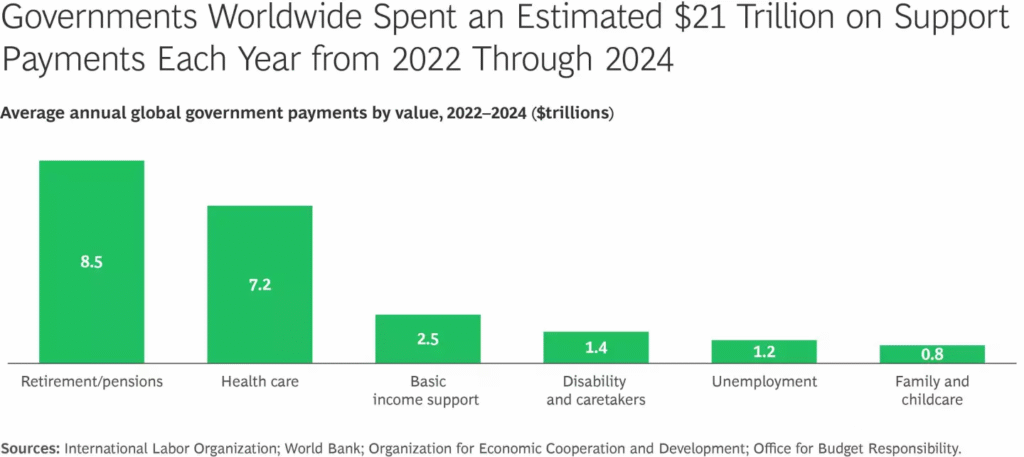
Chart via Boston Consulting Group.
Source: Closing the Trillion-Dollar Gap in Public Payments – Boston Consulting Group